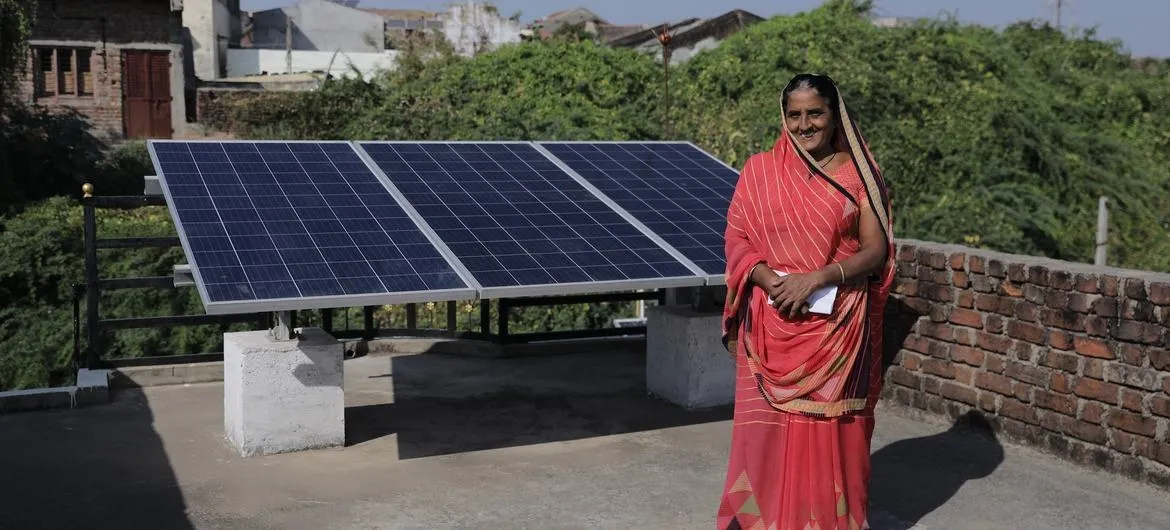
Homes using under 100 units a month get up to ₹17,500 extra from the state.
Details
Homes using under 100 units a month get extra state support on top of the central subsidy: ₹17,500 (BPL) or ₹15,000 (SC/ST) for a 1 kW system. Many families pay only ₹2,500–10,000.
Daytime units cost less and evening units more, so solar plus a home battery saves the most.
Details
With smart ToD meters, daytime units get a rebate and evening units cost more. Homes on net metering still get full credit for their solar, and a home battery covers the costly evening hours.
Housing societies: solar ₹18,000/kW + EV charger support
₹18,000/kW for common-area solar, plus up to 100% support for public EV chargers.
Details
Societies get ₹18,000/kW for common-area solar (up to 500 kW). Under PM E-DRIVE, residential colonies, hospitals and colleges that open chargers to the public can get up to 100% of charger and wiring costs.
Power from 5 pm to midnight costs 25% more; 9 am – 5 pm gets a 15–25% rebate.
Details
For industrial and commercial consumers in Maharashtra, power from 5 pm to midnight costs 25% more, while 9 am – 5 pm units get a 15–25% rebate (rising to 20–30%). Storing cheap daytime energy for the evening is now worth real money.
Banked solar can now be drawn only 9 am – 5 pm, and unused units lapse monthly.
Details
For C&I, captive and open-access solar, banked daytime units can now be drawn only between 9 am and 5 pm, and unused units lapse every month. Right-size your plant and add a battery to use solar in the evening.
Storage now required for new projects above 100 kW
New renewable projects above 100 kW must now include energy storage (BESS).
Details
Under Maharashtra’s Renewable Energy & Energy Storage Policy 2025–36, new renewable projects above 100 kW, including open access, must install energy storage. A September 2026 MERC draft proposes the same for rooftop and behind-the-meter systems above 100 kW (50% of solar capacity for 2 hours, or 25% for 4 hours).
Claim 40% depreciation in year one, or go zero-investment with OPEX solar.
Details
Businesses can claim 40% depreciation on solar plants in the first year, which cuts tax and shortens payback. Or choose zero-investment OPEX solar and pay only per unit.
Peak power costs about ₹12/unit; energy from a battery costs about ₹6/unit.
Details
Peak-hour energy charges in Maharashtra are about ₹12/unit, while recent 4-hour battery-linked bids are around ₹6–6.5/unit. Shifting energy with a BESS can roughly halve your evening power cost.
₹5,400 crore approved for 30 GWh of new battery storage across India.
Details
The Ministry of Power approved ₹5,400 crore of viability gap funding for 30 GWh of battery storage, on top of 13 GWh already under way. Storage is becoming a standard part of India’s grid and of every large solar plant.
Up to 100% of charger and wiring costs for public charging sites, till March 2028.
Details
PM E-DRIVE funds 72,300 public chargers. Government offices, residential colonies, hospitals and colleges get up to 100%; fuel stations, bus and railway stations and toll plazas get 80% of wiring/transformer costs and 70% of charger cost; malls, markets and highway amenities get 80% of wiring costs.
Charging-station power is capped at the average cost of supply: 0.7× in solar hours.
Details
EV charging connections get a single-part tariff capped at the average cost of supply till March 2028: 0.7× during solar hours (9 am – 4 pm) and 1.3× at other times. Add solar and a battery to charge at the lowest cost.
State capital support for public DC fast chargers, with charging every 25 km on highways.
Details
The ₹1,993 crore Maharashtra EV Policy 2025–30 gives capital support for public DC fast chargers and plans charging every 25 km on major highways, at fuel stations and bus depots.
Home bills use MSEDCL LT-I slabs (MERC Case 217 of 2024 (MSEDCL MYT order), FY 2026-27): energy charge + wheeling + fixed charge + 16% duty, with net metering. Prices are indicative; exact figures after a free site survey.
FAQs
Subsidy questions
Checked against MNRE, PIB, MERC, MSEDCL and bank sources on 1 October 2026. Schemes change, so we confirm the current rules during your free analysis.
How much is the PM Surya Ghar subsidy?
₹30,000 per kW for the first 2 kW and ₹18,000 for the 3rd kW: ₹30,000 for 1 kW, ₹60,000 for 2 kW and ₹78,000 for 3 kW and above.
Till when is PM Surya Ghar open?
The scheme is funded till FY 2026-27 (March 2027). The subsidy is paid only after installation, net metering and inspection, so it is best to start early.
Which panels qualify for subsidy?
Subsidised home systems must use DCR panels (made in India with Indian cells) from ALMM-listed makers, installed by a vendor registered on the portal.
How long does the subsidy take?
It is credited to your bank account after installation, net-meter commissioning and DISCOM inspection are completed on the national portal.
How does the calculator work?
It uses the real MSEDCL residential slabs (MERC Case 217 of 2024 (MSEDCL MYT order), FY 2026-27), about 3.8 units per kW per day, panel ageing of 0.5% a year and a 3% yearly tariff rise. It shows your price after subsidy, an EMI next to your current bill, and 25-year savings.
Talk to us
Check your subsidy
Share your name and mobile. We call you back, study your bill and site, and send a clear quotation.